A Pre-release for founding members: a decentralized Medium for everyone still paying rent on someone else’s platform.
Some launches drop a changelog.
A handful leave with the audience, the leverage, the data, and the liquidity.
Everyone else gets a polite download link and a dashboard that just quietly rewrote the rules.
Pre-release access: this member preview starts with the invite-only founding-member roster. It opens the publishing spine first. Identity, federation, governance, and the full network follow.
Crypto taught us the only question that matters before you trust the interface:
Who actually holds the keys?
Citadel brings that question to publishing.
Your post should have an inspectable source of truth.
Your publication should be able to leave any platform without asking permission.
Your community should keep its entire history when the algorithm changes its mind.
The mission is simple and ruthless: give creators and users real ownership of what they build online—their content, their tools, their memberships, their revenue, and eventually the knowledge they create with AI.
No more choosing between beautiful software and being locked inside someone else’s walled garden.
This pre-release is deliberately focused.
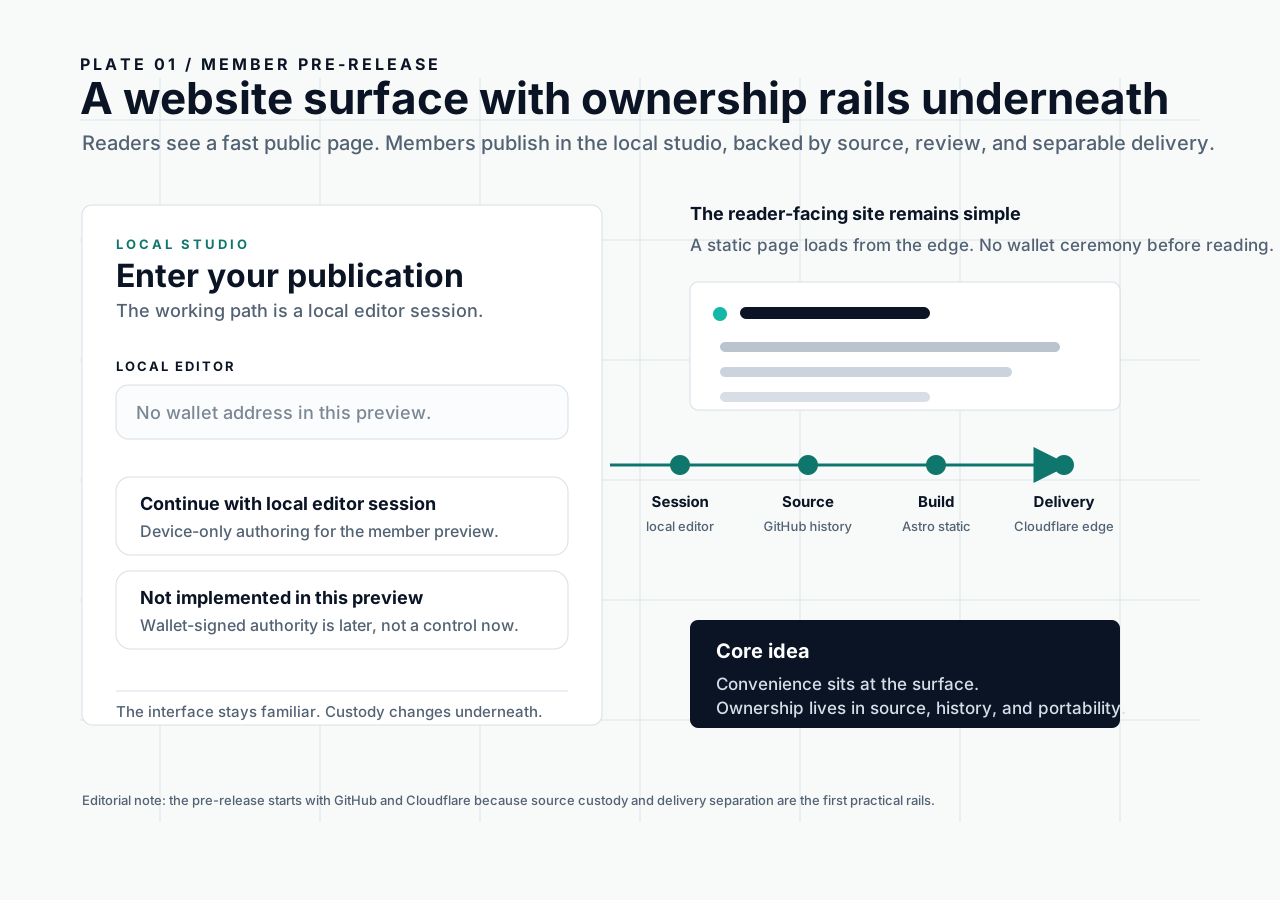
Open the local studio.
Edit the page.
Review every change.
Store the source in GitHub.
Deliver the public site through Cloudflare.
Give your work a home that exists outside the editor that created it.
To readers it feels like a lightning-fast website.
To the publication it is source control, immutable history, reviewable changes, and a clean escape hatch.
What the pre-release contains
This is the genesis layer of Citadel publishing—the first usable piece of a decentralized Medium where writers own their words like private keys, readers will own their identity, and communities participate as true equals.
Publishing comes first because content is where ownership stops being abstract and becomes visible.
The member pre-release includes:
- An invite-only founding-member preview while we harden the foundation.
- A complete Git-backed content model covering posts, docs, metadata, feature images, and publishing state.
- GitHub as the ownership rail—full source control, diffs, history, review flows, and true portability.
- Cloudflare as the delivery rail—blazing-fast static pages at the edge while the source stays sovereign.
- Local studio workflows built for real editorial life: local editing, content review, and reviewed updates.
- Local editor sessions are implemented in the current source; cryptographically signed publishing authority is planned, not shipped.
- Astro static output that keeps the public site fast, cheap, and ridiculously easy to move.
The social graph, reader-owned identity, governance, and federation are coming. This pre-release gives them something they have never had before: a sovereign, source-backed foundation instead of another rented dashboard.
The internet has enough landlords
Medium made publishing feel effortless.
Social networks made distribution feel free.
Newsletter tools made audience ownership sound solved.
Then the bill came due.
Your login lives on their server.
Your graph lives in their database.
Your reach lives at the mercy of their algorithm.
Analytics, subscriptions, moderation, exports—everything funnels through the same landlord.
Crypto natives have seen this exact movie in every other market.
A hosted audience is just a custodial wallet with nicer fonts. It feels like yours until the day you need permission to touch it.
Publishing is where culture actually compounds.
Posts become archives.
Archives become reputation.
Reputation becomes distribution.
Distribution becomes power.
Citadel starts by pulling the work itself out of the trap.
Before readers own identity and communities own governance, the publication needs a clean, portable, auditable source layer that no single company can kill or censor.
Decentralization needs receipts
Vitalik Buterin gave us three brutally clear questions:
- Architectural: how many pieces can break before the whole thing dies?
- Political: how many independent actors can actually change the rules?
- Logical: can the system split and both sides keep running?
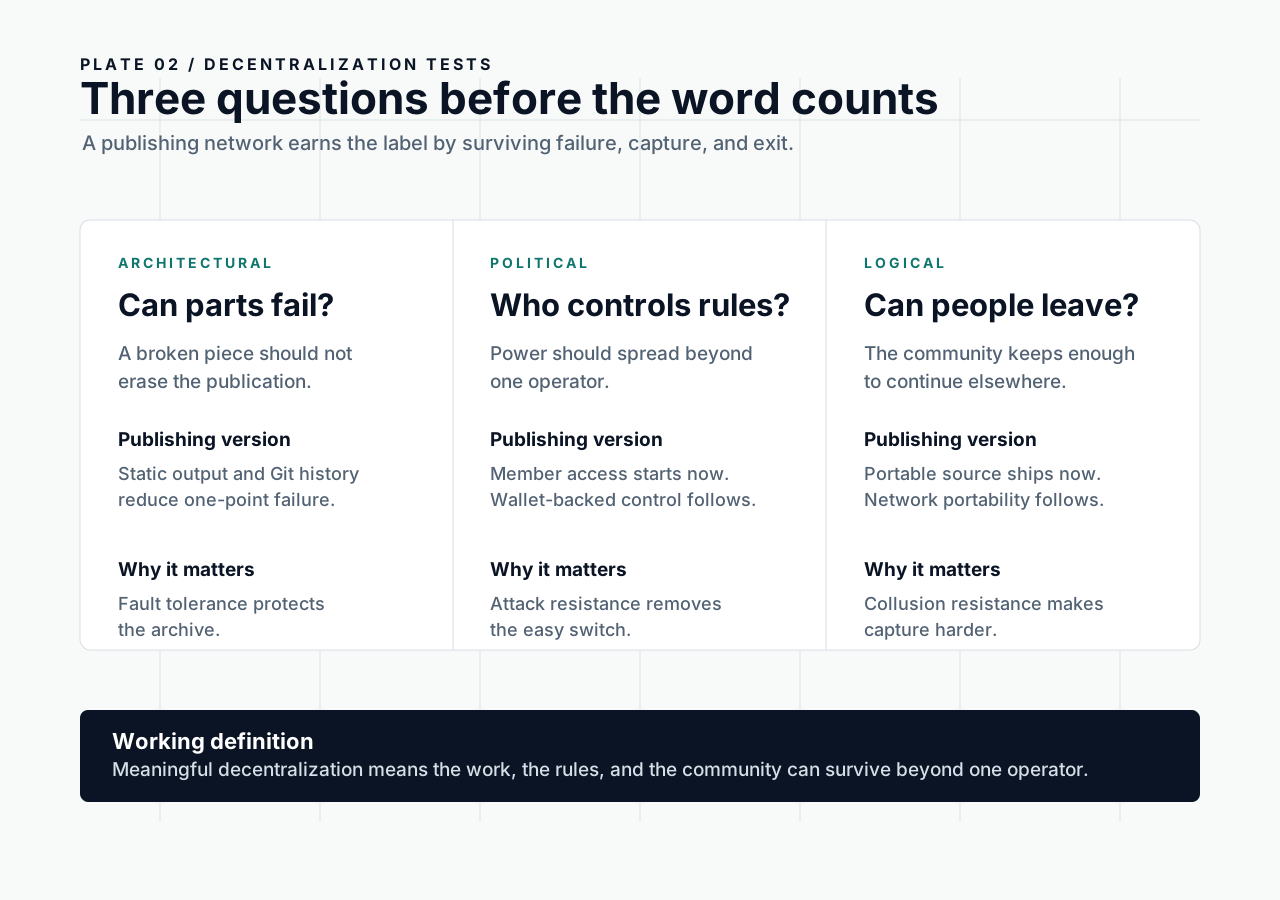
For publishing those questions become painfully practical:
Can one outage delete your publication?
Can one owner rewrite the rules overnight?
Can your community walk away and still stay alive?
Citadel’s pre-release answers the first layer hard.
Content becomes verifiable source.
Changes become reviewable.
Delivery becomes completely separable from ownership.
Everything else in the network only works if the work itself already has a sovereign place to stand.
The publishing foundation that exists in source
The member preview implements the spine.
Posts and documents move from the local studio straight into canonical source files living in GitHub. Teams review diffs, track every edit, and rebuild the entire publication from source. Astro turns it into static pages. Cloudflare serves them at the edge.
A database row behind a login is a promise.
A version-controlled source file with full history is proof.
Posts can be audited.
Changes can be reverted.
Sites can be rebuilt anywhere.
Publications can migrate hosts.
Archives can outlive the tool that created them.
Current scope:
- Fully realized content model.
- Local-only studio prototype; the hosted studio is deferred.
- Real Git-backed review and history.
- Git-tracked source and Cloudflare Workers delivery (manual uploads; no hosted integration).
- Static Astro output.
The full decentralized network is coming. This pre-release builds it a backbone that cannot be taken away.
The Studio: Editorial workflow without compromise
Ownership infrastructure is worthless if only developers can use it.
The local studio gives writers exactly what they expect—titles, excerpts, feature images, rich body content, metadata, review diffs, and publishing state—all in one clean interface.
Local sessions keep the current workflow frictionless. Wallet-signed publishing authority is on the roadmap, not implemented.
Write like a creator.
Review like an operator.
Publish like the source actually matters.
Static delivery, sovereign source
Static is the quiet win that changes everything.
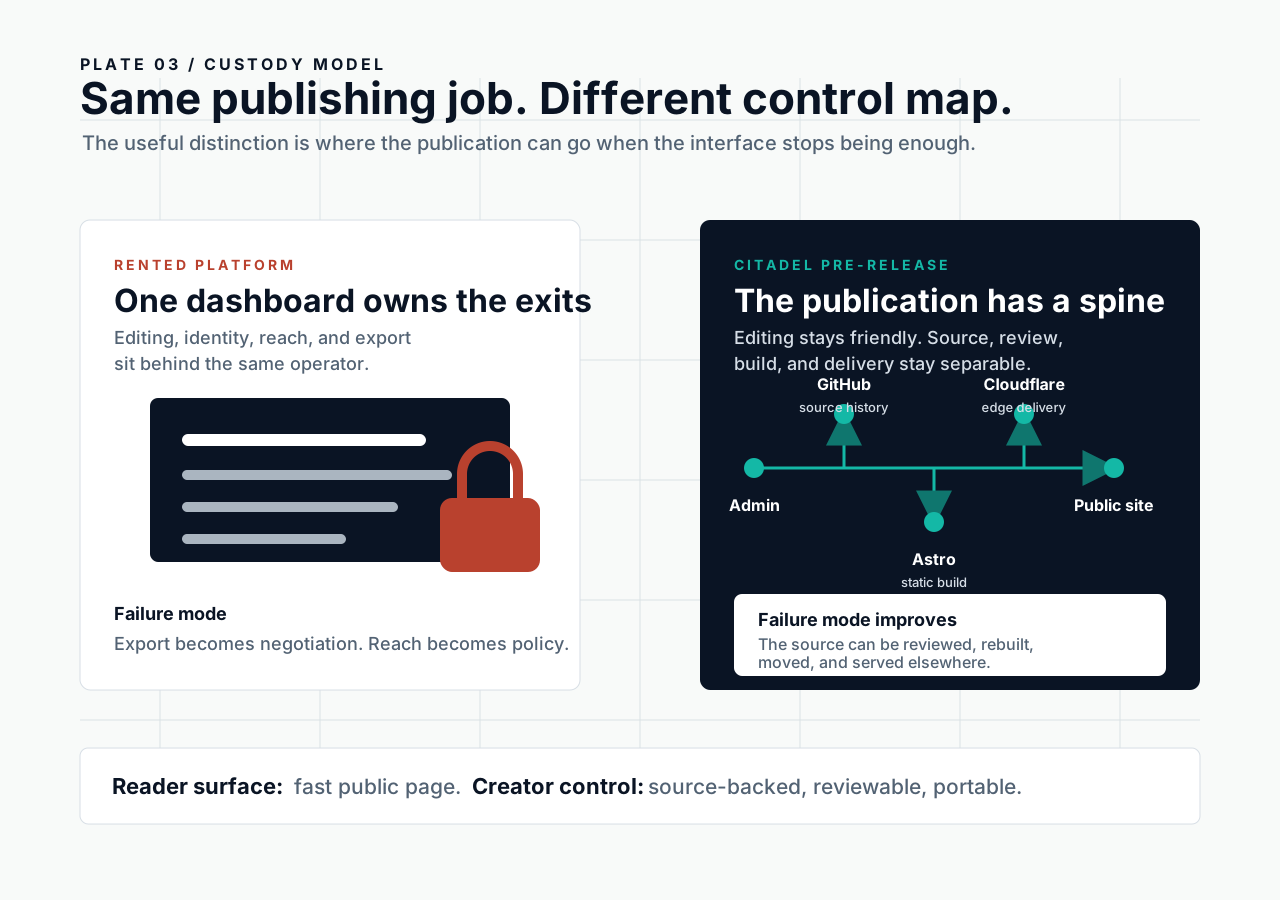
Astro pre-builds every page. Cloudflare serves it from the edge. GitHub keeps the source transparent and immutable. The local studio handles editorial flow, but the content never lives trapped inside it.
Cloudflare = delivery.
GitHub = history.
Astro = build.
Studio = workflow.
Each layer does one job. No single point of failure owns your publication.
Non-technical users get speed and reliability.
Crypto-native users get something that finally feels familiar: real separation of control from convenience.
What comes next
The network builds on top of this unbreakable source layer.
Portable identity that travels with you.
Reader-owned relationships that no platform can inventory.
Public archives anyone can mirror.
Discovery that doesn’t rely on algorithmic slot machines.
Governance that lets communities steer without recreating the same capture problem.
This is how you build a decentralized Medium that never becomes “Medium with extra steps and a wallet button.”
A place to publish like you own it
The old web trained creators to plant their flag on rented land.
Crypto taught us to demand the keys.
Citadel turns that lesson inward.
Who owns the post?
Who owns the archive?
Who owns the relationship?
Who can change the rules?
For founding members, the answer is implemented in the current source: source-backed publishing, GitHub review, Cloudflare delivery, local studio editing, and static output you can move anywhere—anytime.
Platform capture stops being funny the moment your work, your audience, and your history appear on someone else’s invoice.
Publish like you own it.
Because this time, we are all Equal.